How to be Well Read by John Sutherland
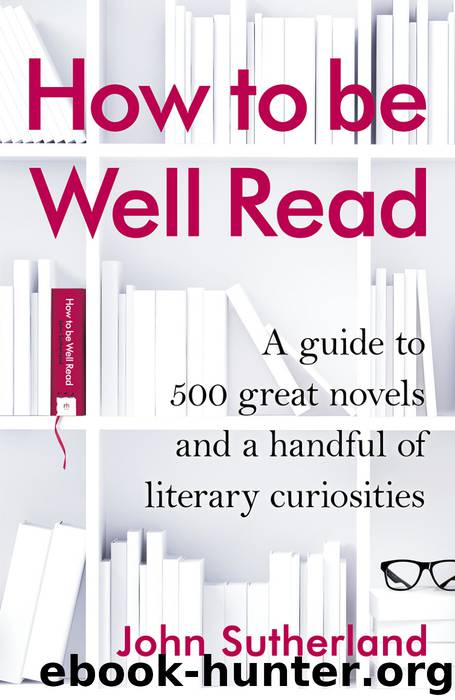
Author:John Sutherland [John Sutherland]
Language: eng
Format: epub
Publisher: Random House
Published: 2014-04-08T16:00:00+00:00
Invisible Man, Ralph Ellison, 1952
As there are ‘Great White Hopes’ in the world of boxing so, in fiction, there have been great black hopes. It was unfair – and, as his life-story confirms, ultimately crippling – for Ralph Ellison to have that role imposed on him. Invisible Man is a minor classic of genuine social significance crushed by over-promotion and America’s mistaken sense that misplaced literary praise is reparation for centuries of oppression. The author himself, in his speech accepting the 1953 National Book Award for the best novel of the last year, recorded his dismay that his ‘attempt at a major novel’ had been so honoured. It looked like tokenism in the year of Hemingway’s The Old Man and the Sea and Steinbeck’s EAST OF EDEN.
Like other African-Americans – Paul Robeson and Richard Wright, notably – Ellison had had premature hopes that Marxism would liberate his people. Invisible Man, which he began in 1945, was written in a spirit of total disillusion with Moscow. He initially planned a short novel and in 1947 published a core element – the ‘Battle Royal’, in which, for the delectation of jeering white men, black men are stripped naked, blindfolded, and made to fight each other in a boxing ring for delusory prizes. The full-length novel hinges on another conceit:
‘I am an invisible man. No, I am not a spook like those who haunted Edgar Allan Poe; nor am I one of your Hollywood-movie ectoplasms. I am a man of substance, of flesh and bone, fibre and liquids – and I might even be said to possess a mind. I am invisible, understand, simply because people refuse to see me.’
In an interview with the Paris Review, Ellison elaborated the point:
There is the joke Negroes tell on themselves about their being so black they can’t be seen in the dark. In my book this sort of thing was merged with the meanings which blackness and light have long had in Western mythology: evil and goodness, ignorance and knowledge, and so on.
Invisible Man is permeated by jazz – strictly the music that came from New Orleans. Although he revered T. S. Eliot’s The Waste Land, and cited it as an inspiration, Ellison reportedly loathed modern jazz (‘too white’). He loved the improvisational freedom of the great African-American art form: one of the few freedoms his people could claim. Louis Armstrong’s ‘(What Did I Do to Be So) Black and Blue’ haunts the novel like a theme song.
The mainframe of Invisible Man is Dostoevsky’s Notes from Underground. The nameless narrator-hero lives in a large cellar, siphoning off electricity from ‘the Monopolated Light & Power Company’ in a huge, subterranean light show (1,369 light bulbs). Southern-born, he is two generations from slavery. On his deathbed his grandfather instructed:
I want you to overcome ’em [the whites] with yeses, undermine ’em with grins, agree ’em to death and destruction, let ’em swoller you till they vomit or bust wide open.
Negro college-educated (his prize for excelling in the Battle Royal), the Invisible Man came north to Harlem.
Download
This site does not store any files on its server. We only index and link to content provided by other sites. Please contact the content providers to delete copyright contents if any and email us, we'll remove relevant links or contents immediately.
| Books & Reading | Comparative Literature |
| Criticism & Theory | Genres & Styles |
| Movements & Periods | Reference |
| Regional & Cultural | Women Authors |
4 3 2 1: A Novel by Paul Auster(12359)
The handmaid's tale by Margaret Atwood(7737)
Giovanni's Room by James Baldwin(7309)
Asking the Right Questions: A Guide to Critical Thinking by M. Neil Browne & Stuart M. Keeley(5745)
Big Magic: Creative Living Beyond Fear by Elizabeth Gilbert(5733)
Ego Is the Enemy by Ryan Holiday(5400)
The Body: A Guide for Occupants by Bill Bryson(5067)
On Writing A Memoir of the Craft by Stephen King(4923)
Ken Follett - World without end by Ken Follett(4712)
Adulting by Kelly Williams Brown(4557)
Bluets by Maggie Nelson(4539)
Eat That Frog! by Brian Tracy(4505)
Guilty Pleasures by Laurell K Hamilton(4430)
The Poetry of Pablo Neruda by Pablo Neruda(4084)
Alive: The Story of the Andes Survivors by Piers Paul Read(4013)
White Noise - A Novel by Don DeLillo(3998)
Fingerprints of the Gods by Graham Hancock(3982)
The Book of Joy by Dalai Lama(3965)
The Bookshop by Penelope Fitzgerald(3831)
